
How to spot hail damage on your roof after a Lakewood storm
Hail damage on Lakewood roofs shows up as bruised shingles, dented vents, and granule loss. Here’s how to check your roof safely after a storm.
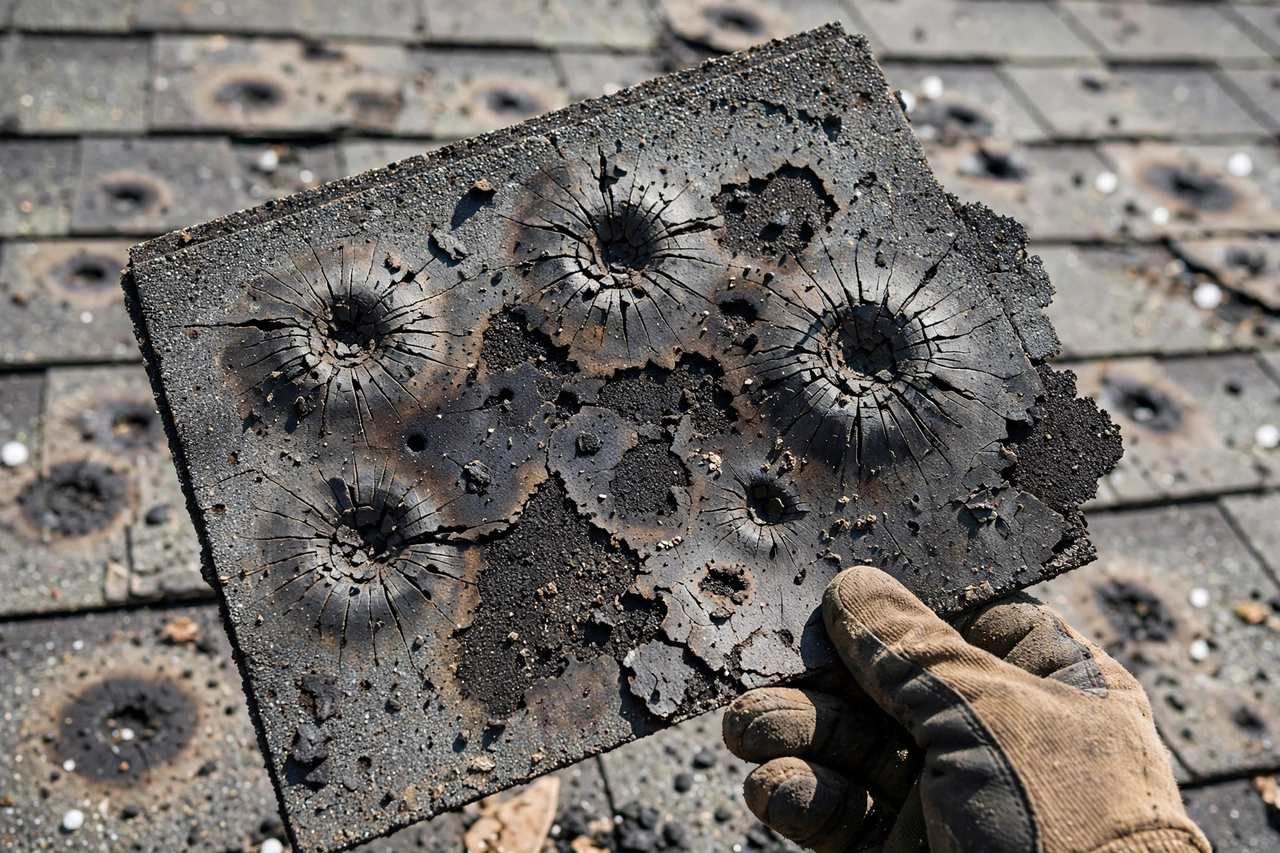
Hail damage on a Lakewood roof looks like bruised or fractured shingles, exposed fiberglass mat, dented vents and flashing, and piles of granules in the gutters. The damage is often invisible from the ground, which is why so many homeowners only find it when a ceiling stain appears months later. This guide walks through the three checks that matter — shingle surface, soft metal, and granule loss — what each one looks like up close, and when it is time to bring in a roofer.
What hail damage actually looks like on a Lakewood roof
Hail damage is a mechanical impact injury, not a stain or a wear pattern. When a hailstone hits an asphalt shingle, it either bruises the mat underneath — a soft, dark spot — or fractures the surface, leaving a cracked, shiny spot. Both compromise the shingle’s ability to shed water.
On a typical architectural shingle, a fresh hail strike looks like a small circular depression about the size of a dime or nickel, sometimes with slightly raised edges. Rub your thumb across it and it feels soft or spongy compared with the surrounding shingle. That softness is the giveaway: granule loss alone can look similar, but a bruise has a distinct give to it. After a few weeks, the bruised spot darkens and the granules around it start to wash away. By the time most homeowners notice, the shingle has already lost its protective layer and the mat is starting to dry out and crack.
The benchmark for what Lakewood hail can do is the 8 May 2017 supercell: baseball-size hail, $2.3 billion in metro-wide insured losses, and Colorado Mills Mall closed until November 2017. NOAA records the largest Lakewood hail that day at 2.00 inches. Hail season here runs mid-April to September, peaking May to July.
How to spot hail damage on your roof in Lakewood
Start with a safe ground-level inspection, then a closer look from a ladder at the eave if you are comfortable. Never walk a hail-damaged roof: the surface is slick and the shingles may be structurally weakened. Work in this order:
- Check the ground first. Look for shingle granules in gutters, downspout splash blocks, and at the base of downspouts. A heavy granule deposit after a storm is a strong signal.
- Inspect soft metal. Gutters, downspouts, vents, valley flashing, and roof caps are the best hail indicators. Dents here mean hail was large enough to damage shingles.
- Look at the shingle field. From a ladder at the eave, scan for dark spots, shiny spots, or areas where granules are missing in a random pattern — not the even wear you see on an old roof.
- Check ridge caps and hips. These take direct hits and often show bruising before the field shingles do.
- Look at skylights and vents. Cracked skylight glazing and dented vent hoods are common after Lakewood hail.
If you find dents on metal but the shingles look fine from the ladder, that is not a clean bill of health. Hail that dents aluminum guttering is usually large enough to bruise shingles on the same slope. A roof inspection in Lakewood from a trained eye will confirm what is actually happening up there.
The soft-metal test: your best clue from the ground
The soft-metal test is the fastest way to know whether a storm was severe enough to damage your roof. Walk your property and check these surfaces:
- Gutter aprons and downspouts — aluminum dents easily
- Roof vents and pipe boots
- Valley flashing and chimney flashing
- Window screens and air-conditioning condenser fins
- Wood fence tops and deck rails — look for fresh impact marks
If you see dents on two or more of these, hail was likely large enough to damage asphalt shingles. One caution: not every dent is from this storm. Old dents from a previous hail event can confuse the picture. Note the freshness — bare metal, sharp edges, and no oxidation around the dent mean it is recent. Photograph what you find, dated, before anything is repaired: those photos are the record your insurer will want.
What does hail damage look like on shingles in Lakewood CO?
Hail damage on shingles comes in four main patterns:
- Bruises. Soft, dark spots where the mat is crushed. Hard to see from standing height, obvious when you are on the roof.
- Fractures. Cracks or splits in the shingle surface, often with a shiny or exposed-fiberglass center.
- Granule loss. Random patches where the protective granules are gone, exposing the black asphalt underneath.
- Loosened or missing shingles. Hail combined with wind can lift tabs and tear shingles at the nail line.
On architectural shingles installed in the last 10 to 15 years, hail damage is often subtle. The thicker mat absorbs more impact, so the bruise is smaller and harder to spot. On a metal roof you will see dents in the panels — cosmetic on some systems, a real problem on others. On low-slope membranes, hail punctures rather than bruises, and ponding water hides the damage; see our flat roof repair page for that case.
Why Lakewood hail hits harder than most homeowners expect
Lakewood sits in the heart of Colorado’s hail country. Warm spring afternoons push moist air up against the foothills, and the resulting storms drop hailstones that can reach golf-ball size or larger. Most asphalt shingles are tested to withstand hail up to about 1 inch in diameter. Anything larger — and Lakewood sees plenty larger — can bruise or fracture the mat.
What makes Lakewood different from a town on the plains is the terrain. The subtle elevation changes and proximity to the foothills can intensify storms right over one neighborhood while the next one over gets pea-sized hail. A storm that drops small hail in one part of the metro can hammer a single Lakewood neighborhood with 1.5-inch stones. That is why a neighbor’s clean roof does not mean yours is clean — and why a hail damage roof repair assessment in Lakewood is worth booking after any storm that drops stones bigger than a dime.
Common mistakes homeowners make after a hail storm
- Waiting. Hail damage rarely leaks immediately, but the bruised shingle dries out, cracks, and lets water in over the following months. By the time you see a ceiling stain, the damage has spread.
- Climbing on the roof yourself. Hail-damaged shingles are slick and unstable. A fall from a two-storey Lakewood home is a serious injury.
- Assuming your insurance will not cover it. Most Colorado homeowner policies cover hail damage, minus your deductible. The key is documenting it properly and filing within your policy’s deadline — deadlines vary by policy, so check yours. See our guide to filing a storm damage claim.
- Hiring an out-of-town crew. After every major hail event, crews from outside the area canvass Lakewood neighborhoods. A roofer with a verifiable Lakewood address is the safer call.
- Signing a contract before you have an inspection report. You cannot know the scope of repair until someone has actually been on the roof. Under SB 12-038 you have a 72-hour right to cancel a roofing contract — use it to read the scope.
- Replacing dented gutters and vents before the claim is filed. Dented soft metal is evidence your adjuster will look for. Leave it in place until the claim is documented.
When to call a professional
Call a professional if you see any of the following: dents on two or more soft-metal surfaces, granules washing into your gutters in noticeable amounts, dark or shiny spots on shingles, or any interior sign of a leak — a ceiling stain, attic moisture, or a musty smell.
Roof Authority LLC inspects residential roofs across Lakewood, including Eiber and Green Mountain, and documents everything with photos you can hand to your insurance adjuster. If the roof is repairable, we repair it. If it needs replacement, we tell you that too — and we walk you through the claim process. We also handle storm damage roof repair in Lakewood for wind and hail combined, which is common here: one storm can bruise shingles and tear off tabs at the same time. Call (720) 817-3348.
Frequently Asked Questions
How to spot hail damage on your roof in Lakewood?
Check soft metal first: gutters, vents, and flashing. Dents there mean hail was large enough to bruise shingles. Then look for dark, soft spots on shingles, granule loss in gutters, and cracked or missing shingle tabs.
What does hail damage look like on shingles in Lakewood CO?
Small circular bruises (soft, dark spots), fractures with exposed fiberglass, random patches of granule loss, and sometimes loosened or missing shingles. On architectural shingles the damage is often subtle: a dime-sized soft spot you can only feel, not see, from the ground.
Who inspects hail damage roofs in Lakewood?
Roofing contractors with hail-damage experience inspect roofs in Lakewood. Roof Authority LLC provides photo documentation, a written assessment, and a repair or replacement recommendation, and can be present when the insurance adjuster visits.
Does insurance cover hail damage in Lakewood?
Most Colorado homeowner policies cover hail damage to roofs, minus your deductible. File within your policy deadline, which varies by policy, and get an inspection first so you know the scope before you file.
How long does hail damage take to show up?
Bruises and fractures are visible immediately after the storm if you know where to look. Granule loss and shingle cracking develop over months, and interior leaks often appear later, which is why a post-storm inspection matters even if your roof looks fine from the ground.
Get help with Roofing in lakewood
If a storm rolled through your neighborhood and you are not sure whether your roof took a hit, call (720) 817-3348. We will inspect it, document what we find with photos, and tell you plainly whether it needs repair, replacement, or nothing at all.
Roof Authority LLC is based at 200 Union Blvd, Lakewood, CO 80228, and works Monday to Saturday, 7:00 AM to 5:00 PM. Phone is the way to reach us.