
How to file a storm damage roof insurance claim in Lakewood
Document the damage, call your insurer, meet the adjuster, and get a written scope from your roofer. That is the whole process — and the order matters.
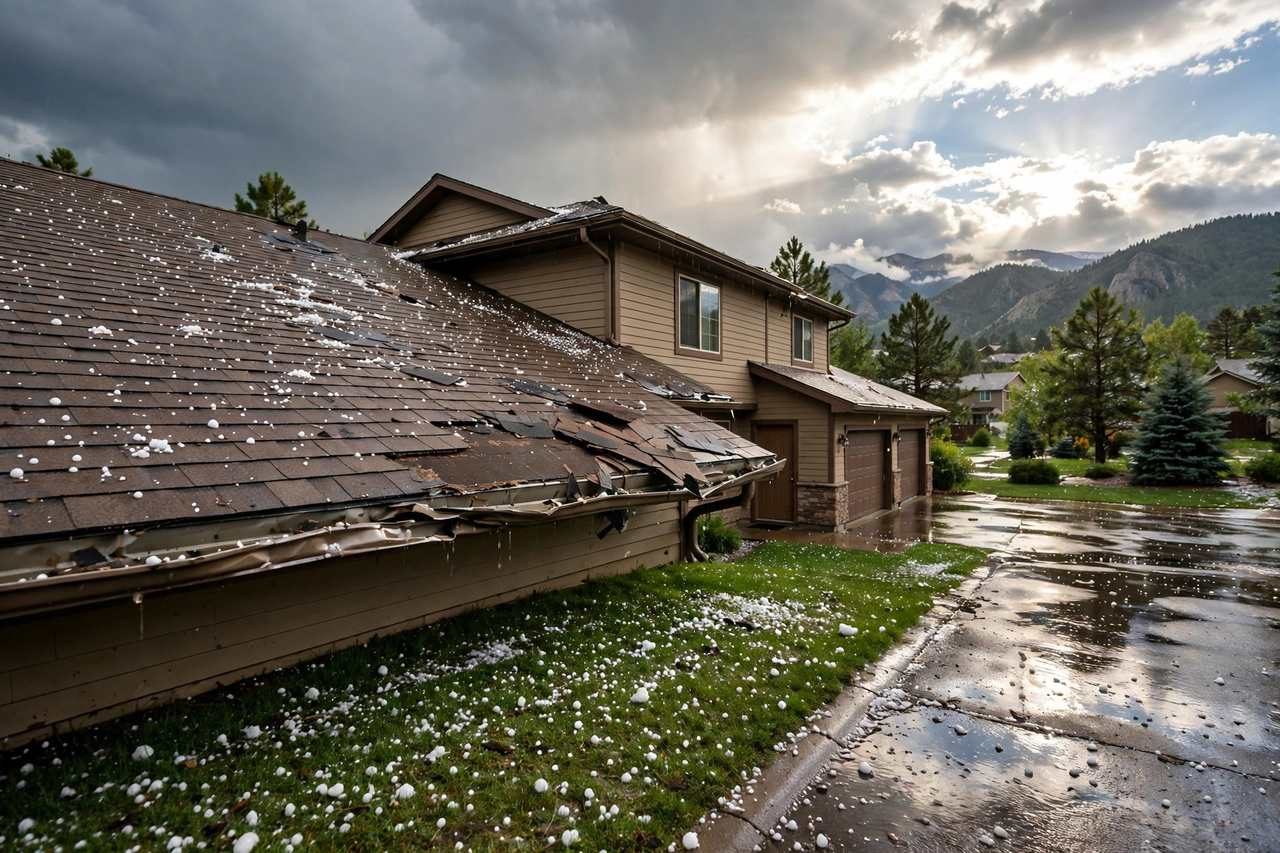
A storm damage claim is a process, not a negotiation trick. Your insurer needs evidence, your adjuster needs access, and your roofer needs a written scope. Colorado law sets clear boundaries around what a roofer may and may not do in that process, and knowing them before you file protects both your claim and your roof. This guide walks through the steps in order, explains the law in plain language, and names the mistakes that shrink or kill claims.
Filing a storm damage roof insurance claim in Lakewood
- Document the damage before anything is moved or repaired. Dated photos from the ground: the roof, gutters, vents, and any interior water. Note the storm date and time. If a tree is involved, photograph it in place before it is moved.
- Get a roofer’s inspection and a written scope. The scope, with photos, names the damaged areas, the materials, and the deck condition. This is the document the adjuster works from. See our roof inspection and hail damage roof repair pages.
- Call your insurer and open the claim. Give them the storm date, the damage you can see, and the roofer’s scope if you have it. Ask for the claim number and the deadline your policy sets for filing — deadlines vary by policy, so check yours rather than assuming a standard window.
- Meet the adjuster — with your roofer present if you can arrange it. The adjuster inspects the roof and writes the insurer’s scope. Your roofer being there helps, because the roofer knows where the damage is and can point to the bruising and granule loss the adjuster needs to see.
- Compare the two scopes. The insurer’s scope and your roofer’s scope should describe the same roof. If they differ, ask your roofer to explain the difference in writing and send it to the insurer as a supplement. That is a normal part of the process.
- Get the work permitted and done. In Lakewood, a permit is required before tear-off on any re-roof or repair of 100 square feet or more, and the City closes out jobs with photo inspections through eTRAKiT.
Does insurance cover storm damage roof in Lakewood CO?
Most Colorado homeowner policies cover sudden storm damage — hail, wind, and falling trees — minus your deductible. What is covered depends on your policy: the cause of the damage, the age and condition of the roof, and any exclusions, including cosmetic-damage exclusions that are becoming more common for metal roofs. Your deductible is your share. Under Colorado law (SB 12-038, 2012), a roofer may not pay, waive, or rebate any part of your deductible, and any roofer who offers to “cover” it is asking you to take part in something the law forbids.
Wear and tear is not storm damage. A roof that is leaking because it is twenty years old and the shingles have worn out is a maintenance and replacement question, not a claim. An inspection with photos is what separates the two — and it is also what protects you if the insurer argues the damage predates the storm.
What the adjuster looks for on a Lakewood roof
The adjuster is looking for functional damage tied to a specific storm: bruised or fractured shingles, granule loss in a random pattern rather than even wear, dented soft metal (gutters, vents, flashing), and lifted or missing tabs. They will also look at the roof’s age and condition, because a roof that was already at the end of its service life is valued differently from a roof that was mid-life when the storm hit.
The strongest position you can be in is to have your own record before the adjuster arrives: dated photos from before the storm if you have them, the roofer’s written scope with photos, and a note of the storm date. In Lakewood, the storm date that matters most is usually 8 May 2017 for older claims, but any recent storm needs its own date and its own documentation. Do not replace dented gutters or vents before the claim is filed — they are evidence.
How long does a roof insurance claim take in Lakewood?
There is no fixed timeline, and anyone who promises one is guessing. The pace depends on your insurer, the size of the claim, whether the adjuster’s scope and the roofer’s scope agree, and how busy the insurer is after a storm. A straightforward claim with good documentation moves faster than one where the scopes disagree and supplements have to be exchanged. The one deadline that matters is the one in your policy: check it, write it down, and do not let it pass while you are deciding.
One timing rule is set by law, not by your policy. Under SB 12-038, you have a 72-hour right to cancel a residential roofing contract. That window exists so you can read the scope before you are bound by it. Use it.
Common mistakes that shrink or kill a claim
- Repairing before documenting. Once the damaged shingles are gone, the evidence is gone. Photograph first, then repair.
- Signing an assignment of benefits. Do not sign any form that assigns your insurance benefits to a contractor. Colorado’s roofing law does not support that arrangement, and it takes control of your claim out of your hands.
- Letting a roofer negotiate the claim. A roofer may document damage, write a scope, and be present at the adjuster’s visit. A roofer may not act as a public adjuster or negotiate your claim for you. That is the line SB 12-038 draws, and crossing it can invalidate the work.
- Accepting a deductible waiver. A roofer who offers to pay or waive your deductible is breaking Colorado law, and the arrangement can come back on you.
- Assuming matching is guaranteed. Colorado has no strict matching statute. If only part of the roof is damaged, ask your insurer how matching is handled under your policy — do not assume the whole roof will be replaced to match.
- Missing your policy’s filing deadline. Deadlines vary by policy. Find yours and calendar it the day you open the claim.
What to do if your roof claim is denied in Lakewood
A denial is not necessarily the end. Ask for the denial in writing, with the specific reason and the policy language it relies on. Then get a second, independent inspection with photos, and compare the denial’s reasoning against what the roof actually shows. If the denial turns on a factual question — whether the damage is storm-related, whether it is functional — a documented second inspection is the strongest response.
If the dispute continues, your options are your insurer’s internal appeal process, the Colorado Division of Insurance, and, for larger disputes, an attorney who handles insurance claims. A roofer cannot represent you in that dispute. What a roofer can do is give you the documented scope the dispute turns on.
When to call a professional
Call a roofer before you file, if you can. The inspection and the written scope are the foundation of the claim, and they are much harder to build after the roof has been repaired or the evidence has been removed. Call (720) 817-3348 after a storm and we will inspect the roof, document the damage with photos, and give you a written scope you can hand to your adjuster. We will be present at the adjuster’s visit if you ask us to be. What we will not do is negotiate your claim, act as a public adjuster, or touch your deductible — Colorado law forbids it, and your claim is safer for it.
Roof Authority LLC works on residential roofs across Lakewood, including Applewood and Green Mountain. See also our storm damage roof repair page.
Frequently Asked Questions
How do I file a storm damage roof claim in Lakewood?
Document the damage with dated photos, get a roofer inspection and a written scope, call your insurer and open the claim, meet the adjuster with your roofer present if you can, and compare the insurer scope with the roofer scope.
Can a roofer negotiate my insurance claim in Colorado?
No. Under Colorado law (SB 12-038, 2012), a roofer may document damage, write a scope, and be present at the adjuster visit, but may not act as a public adjuster or negotiate your claim.
Can a roofer waive my deductible in Colorado?
No. SB 12-038 forbids a roofer from paying, waiving, or rebating any part of your deductible. Any roofer who offers to cover your deductible is asking you to take part in something the law forbids.
How long do I have to file a roof claim after a storm in Lakewood?
Filing deadlines vary by policy, so check your own policy and calendar the deadline the day you open the claim. Do not assume a standard window.
What is the 72-hour rule for roofing contracts in Colorado?
Under SB 12-038, you have a 72-hour right to cancel a residential roofing contract. The window exists so you can read the scope before you are bound by it.
Get help with Roofing in lakewood
If a storm has damaged your roof, call (720) 817-3348 before you file. We will inspect the roof, document the damage with photos, and give you a written scope for your adjuster.
Roof Authority LLC is based at 200 Union Blvd, Lakewood, CO 80228, and works Monday to Saturday, 7:00 AM to 5:00 PM. Phone is the way to reach us.